
CSS Syntax

 A CSS rule consists of a selector and a declaration block.


CSS Syntax
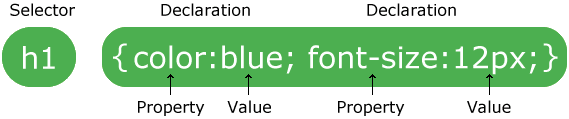
CSS selector

The selector points to the HTML element you want to style.

The declaration block contains one or more declarations separated by semicolons.

Each declaration includes a CSS property name and a value, separated by a colon.

Multiple CSS declarations are separated with semicolons, and declaration blocks are surrounded by curly braces.

Example

In this example all <p> elements will be center-aligned, with a red text color:

{
  color: red;
  text-align: center;
}
Try it Yourself »

Example Explained

  • p is a selector in CSS (it points to the HTML element you want to style: <p>).
  • color is a property, and red is the property value
  • text-align is a property, and center is the property value

You will learn much more about CSS selectors and CSS properties in the next chapters!

Comments

Popular posts from this blog

CSS Comments

Comments are used to explain the code and may help when you edit the source code at a later date. Comments are ignored by browsers. A CSS comment is placed inside the  <style>  element, and starts with  /*  and ends with  */ : Example /* This is a single-line comment */ p  {   color :  red ; } Try it Yourself » You can add comments wherever you want in the code: Example p  {   color :  red ;    /* Set text color to red */ } Try it Yourself » Comments can also span multiple lines:  Example /* This is a multi-line comment */ p  {   color :  red ; } Try it Yourself » HTML and CSS Comments From the HTML tutorial, you learned that you can add comments to your HTML source by using the  <!--...-->  syntax. In the following example, we use a combination of HTML and CSS comments: Example < !DOCTYPE  html > < html > < head > < style > p  {   color : ...

พยางค์

การที่เราเปล่งเสียงออกมาจากลำคอครั้งหนึ่ง ๆ นั้น เราเรียกเสียงที่เปล่งออกมาว่า “พยางค์” แม้ว่าเสียงที่เปล่งออกมาจะมีความหมายหรือไม่มีความหมายก็ตาม เช่น เราเปล่งเสียง “สุ” ถึงจะไม่ รู้ความหมาย หรือไม่รู้เรื่องเราก็เรียกว่า ๑ พยางค์ หากเราเปล่งเสียงออกมาอีกครั้งหนึ่งว่า “กร” จะ เป็น “สุกร” จึงจะมีความหมาย คำว่า “สุกร” ซึ่งเปล่งเสียง ๒ ครั้ง เราก็ถือว่ามี๒ พยางค์ เสียงที่เปล่ง ออกมาครั้งเดียวมีความหมาย เช่น นา หมายถึง ที่ปลูกข้าว เสียงที่เปล่งออกมาว่า “นา” นี้เป็น ๑ พยางค์ ลองดูตัวอย่างต่อไปนี้ ไร่ มี๑ พยางค์ ชาวไร่ มี๒ พยางค์ (ชาว-ไร่) สหกรณ์ มี๓ พยางค์ (สะ-หะ-กอน) โรงพยาบาล มี๔ พยางค์ (โรง-พะ-ยา-บาน) นักศึกษาผู้ใหญ่ มี๕ พยางค์ (นัก-สึก-สา-ผู้-ใหญ่) สหกรณ์การเกษตร มี๖ พยางค์ (สะ-หะ-กอน-การ-กะ-เสด) จากตัวอย่างข้างบนนี้สรุปได้ว่า พยางค์ คือ เสียงที่เปล่งออกมาครั้งหนึ่ง จะมีความหมายหรือไม่มีความหมายก็ตาม ถ้าเปล่ง เสียงออกมา ๑ ครั้ง ก็เรียก ๑ พยางค์ สองครั้งก็เรียก ๒ พยางค์ องค์ประกอบของพยางค์ พยางค์เกิดจากการเปล่งเสียงพยัญชนะ สระ และวรรณยุกต์ออกมาพร้อม ๆ กัน พยางค์ที่มี ความหมายอาจจะเป็นพยา...

OENG Sometri: Lecturer, IT Expert, and Public Administrator

👑 Welcome to the Official Blog of Dr. Candidate OENG Sometri 👑 I am a highly dedicated and experienced professional and educator with a strong foundation in Public Administration , Information Technology Engineering , and Foreign Languages . My commitment is to foster a joyful and supportive learning environment, encouraging students to become creative and problem-solving professionals . 💼 Professional Experience & Current Roles Lecturer of Fundamentals of Computer Networking at IIC, Phnom Penh (Aug 2025 – Present) Lecturer of Web Design & C# Programming at WiDCy Institute, Phnom Penh (Sep 2025 – Present) Instructor of ICT at PSIS, Phnom Penh (Sep 2025 – Present) ICT Trainer & Vice-Manager at Postal Operational Department, Cambodia Post (Mar 2025 – Sep 2025) IT Vice-Manager at IT Center, Cambodia Post (Feb 2023 – Mar 2025) Lecturer (Education/English) at Preah Sihamoniraja Buddhist University (PSBU) (2017 – 2025) Vice-Manager, Postal Operational Department at Camb...